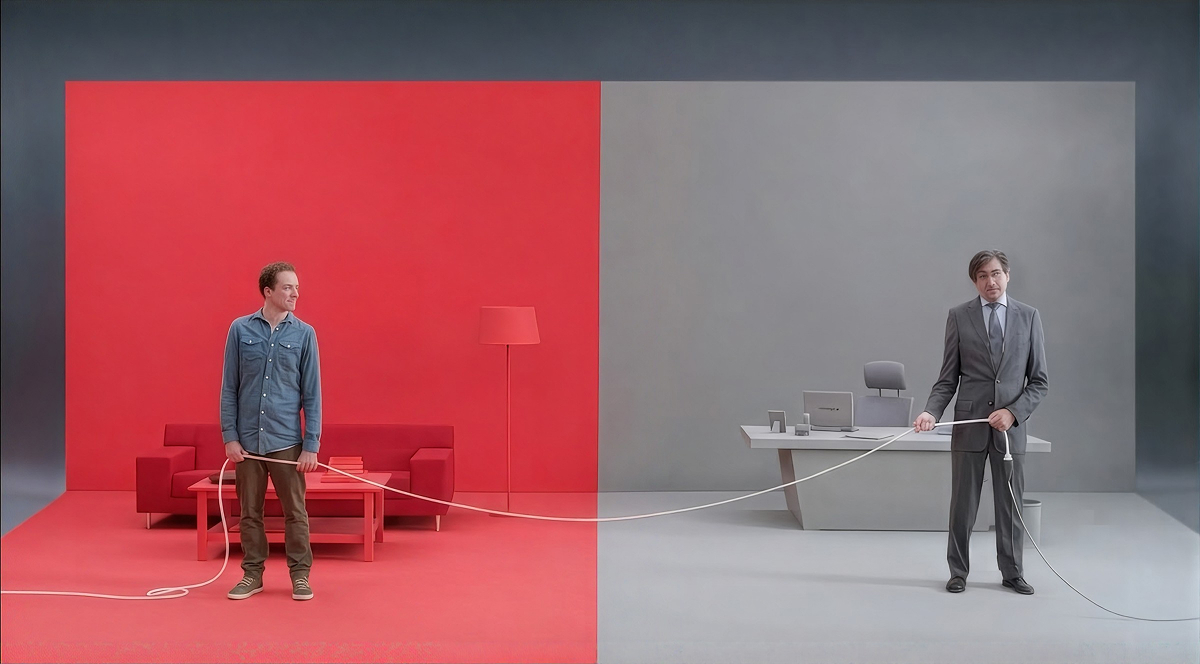

The assisted model: AI as a better tool
Two systems can both be called AI-powered and operate in fundamentally different ways. One waits for you. One doesn’t.
In the assisted model, AI surfaces information and makes recommendations. You review. You approve. You act. The intelligence is real but the decision stays with you.
In practice, this looks like: a dashboard that flags a campaign underperforming against target and suggests increasing the bid. A report that shows your budget is concentrated in one channel and recommends redistributing. An alert that tells you a creative is losing traction and proposes pausing it.
All useful. All dependent on someone reading the alert, agreeing with the recommendation, and acting on it. By the time that happens: hours later, after a meeting, after approval, … the moment has passed.
This model has a structural ceiling: yours.Before any insight generated by the AI can become an action, it must pass through your cognitive bandwidth. At scale, that bottleneck matters.
The autonomous model: AI as a decision-maker
In the autonomous model, the AI doesn’t recommend: it decides. It sets objectives, reads the environment, and takes action. The human defines the goal and the constraints. The AI finds the path.
This isn’t automation in the traditional sense. Traditional automation executes predefined rules. An autonomous agent evaluates whether the rules themselves are still correct.
In advertising terms: a rule-based system might pause a campaign when CPA exceeds a certain limit. An autonomous agent monitors CPA as one of 200+ variables, understands why it’s moving, redistributes budget across channels in real time, and adjusts the campaign architecture, before the CPA threshold is ever breached.
Why the word “autonomous” keeps getting misused
The category is new enough that the terminology is still being settled. Vendors use autonomous to describe systems that require human approval for every change. That’s not autonomous, that’s assisted with a different interface.
True autonomy means the system can pursue its goal without checking in. Not because it’s unmonitored, but because it doesn’t need permission to act.
This distinction has commercial consequences. If you’re using assisted AI and expecting autonomous results, the performance gap won’t be due to budget constraints, creative issues or targeting problems. It will be explained by the fundamental architecture of the system making the decisions.
The question to ask any AI vendor
Before the next meeting with an AI advertising vendor, ask this: ‘When your system identifies an optimization opportunity, what happens next ? Does it act on it, or does it flag it for my team to review?’
The answer tells you everything about which category you’re actually buying.
Assisted AI will tell you what to do. Autonomous AI will carry out the task and explain its reasoning. Mainkore is the latter. It is the only one on the market that guarantees your KPIs by contract.